
transition-maxxing
Success and the City, Ep 4

You know you’ve started to call a place home when you graduate from group-text addition to group-text initiator. The opportunity arrived perfectly: Chehan’s birthday, my first real planner moment in New York, and with a little research I knew what I was doing. I think.
The signs started thirty minutes out. Wrong train. Phone buzzing. Are we going to the restaurant with the door in a tiger mouth?
I had been looking for a vibe — NY, swanky, great for the homies. What I delivered was a choogie, tiger-themed Thai restaurant that, mid-meal, broke into a live performance of that “azavenyaaaa” song from the Lion King.
I was certain no one would ever let me plan anything again. 🫠
Except — it was kinda lit. They serenaded Chehan.
That was weekend two in New York. Weekend six, I sent a group of friends what I thought were directions to a pregame bar in Brooklyn and what turned out to be directions to a strip club. (Oops.) Last summer, my first day in New York, I decided it would be fun to try Citi biking — and lost my phone off the bike within ten minutes. (A kind stranger eventually dropped it back at my apartment 🙏)
This is what the first month of a new city actually looks like.

Welcome back, dear reader. (Episode 4 — hooray for consistency.) Half my friends are mid-transition right now: new cities, new jobs, new versions of themselves. So let’s wonder about it together.
I am a woman of routine. Here’s the thing about routine: it reduces friction. You stop thinking about which subway, which gym, which coffee, which person to text on a hard day. The decisions become muscle memory. You forget you were ever choosing.
A transition is, in contrast, a friction event. Everything that was muscle memory becomes a decision again. The logistical calorie burn of finding a new gym, doctor etc. is quite frankly atrocious.
switching costs
My dad has been thinking about this longer than I have. When I told him about the tiger restaurant, he said something akin to the following (probably not as eloquently put):
Every transition has a switching cost — and the cost isn’t fixed. It shifts with age. At 23, switching costs are low (no mortgage, no husband — again, where the hell IS my husband), and the upside compounds over a 50-year window: every relationship deepens, every lesson informs the next decision, every piece of context you build pays interest for decades. At 50, the math inverts. By then you’ve got the mortgage, the career you’ve spent decades building, the partner whose life is also rooted somewhere, the friend group that took thirty years to assemble. The cost of moving has roughly tripled. The compounding window is half as long. The same transition that’s a great trade at 23 is a bad trade at 50.
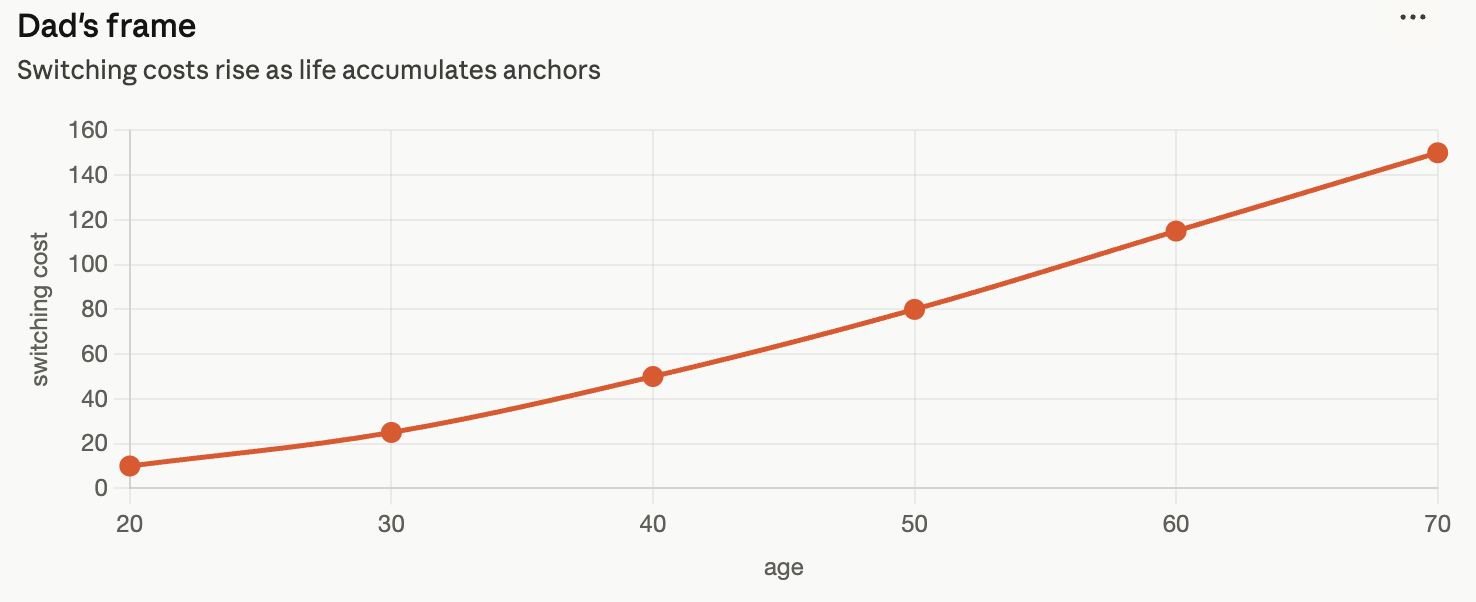
So early in life, you maximize transitions. Not to be chaotic. Because the math says to. And in a very Tina Seelig–Lisa Solomon way (check out their podcast), each transition also increases your surface area for luck — new people, new conversations, new versions of yourself you wouldn’t have met sitting still. The point of those years is to compound the luck across the 50 that follow.
So: moving FEELS like a tax. It’s actually a compounding investment — you pay some pain now for the long-term benefit of the experiences and the surface area.
a missing variable
My good friend Emily pointed out a missing variable in my dad’s equation: transitions are also a learned skill.
Costs don’t only go up with age because life accumulates responsibilities. They also go DOWN because you get better at transitions. Just like #gut, you get reps. You build the muscle. 💪
So the actual shape isn’t a straight line. It’s two forces in tension. Responsibilities push costs up. Skill pulls costs down. The people who transition well at 50 are the ones who never stopped doing it.
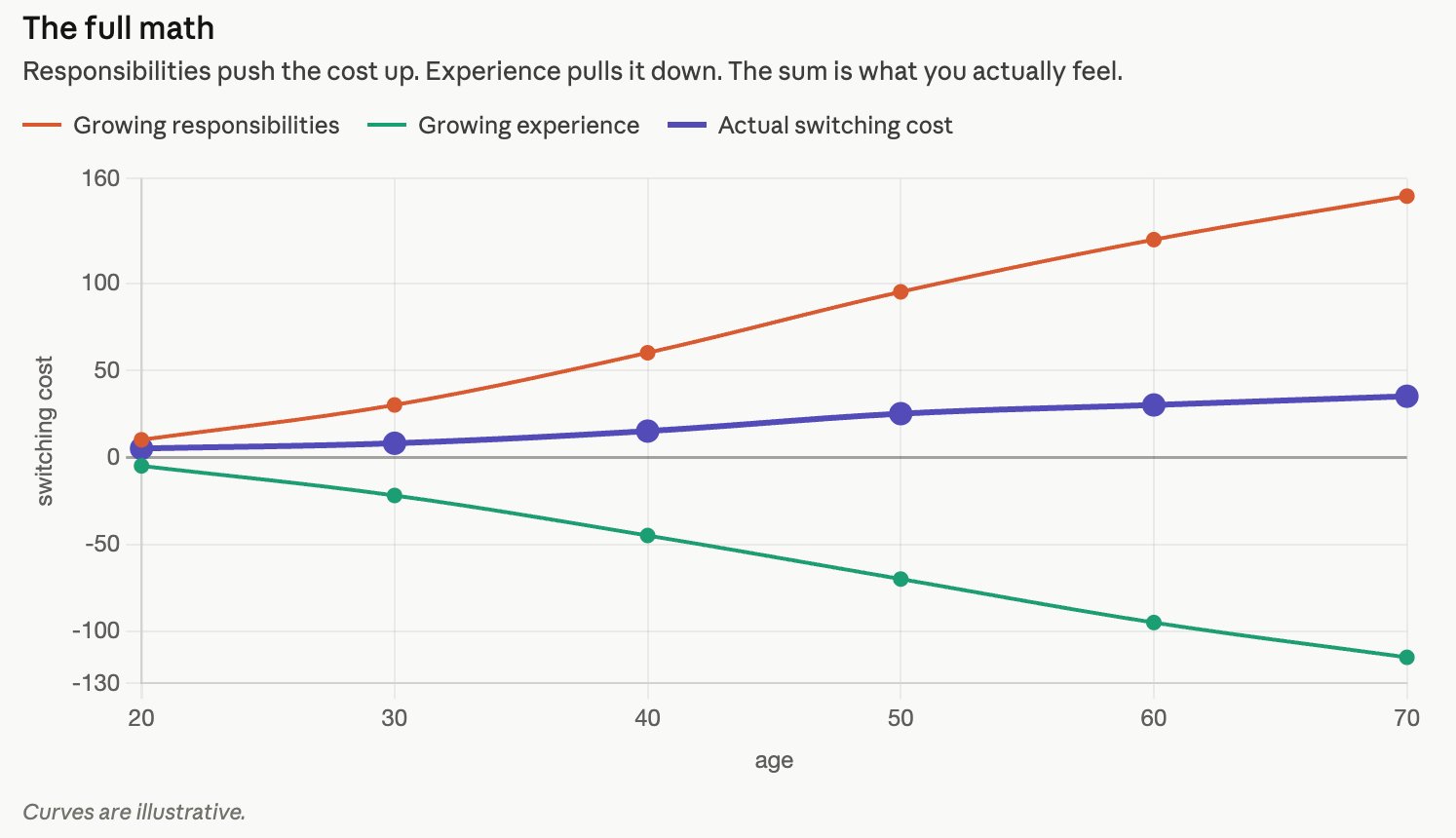
Which means the argument isn’t just max transitions while you’re young. It’s max transitions while you’re young so you stay good at transitioning later. The experiences and the skill both compound. (Each transition I’ve made has taught me something the next one inherits — how to build a rhythm faster, how to ask for help earlier, how to know what I actually need before I have to scramble for it.)
But that still doesn’t tell you how many transitions to take. Or which ones.
transition physics
Case study: I have lived in the same five-mile radius for the first twenty-three years of my life.
By a strict reading of my dad’s frame, I should’ve taken bigger jumps already. More friction, more growth, more compounding. I’d be tougher.
I don’t think that’s the complete picture, though. I think I redirected the energy.
In physics, friction doesn’t destroy energy. It transforms it. Rub your hands together; friction warms them. The energy isn’t lost. It’s transferred.
The same is true of the energy you DON’T spend on a transition. What I would’ve spent on a new coast, or new weather patterns, went into hosting from year one, into being a tour guide for my friends, into already knowing my professors. That compounded too. Different shape, same physics.
Staying isn’t more virtuous than leaving. Energy just goes somewhere either way — and the switching costs frame has to make room for both. Energy is finite. Every transition you take is an opt-in to spend a chunk of your friction budget on logistics and belonging. Every transition you don’t take is energy redirected somewhere else.
I see this play out literally every week as I commute to DC for work. The energy I spend on travel — the airport, the hotel, the resetting — is energy not going somewhere else. Sometimes that’s the right trade. Sometimes I notice the bill on the back end.
The question isn’t are you transitioning enough. It’s not even are you taking enough risk. The question is: where is your energy actually going — and what are you losing in the friction?
the transition pyramid
So if transitions are a skill, and the switching costs are real — how do we actually approach them?
My answer: iteratively. And with humor.
Maslow gave us a hierarchy of needs — physiological, safety, belonging, esteem, self-actualization — each layer making the next one possible. The same shape applies to transitions. I think I stole this twist from Peyton: your own personal hierarchy of what gets rebuilt, in what order. It makes the enormity of change feel a little more manageable. Mine looks something like this:
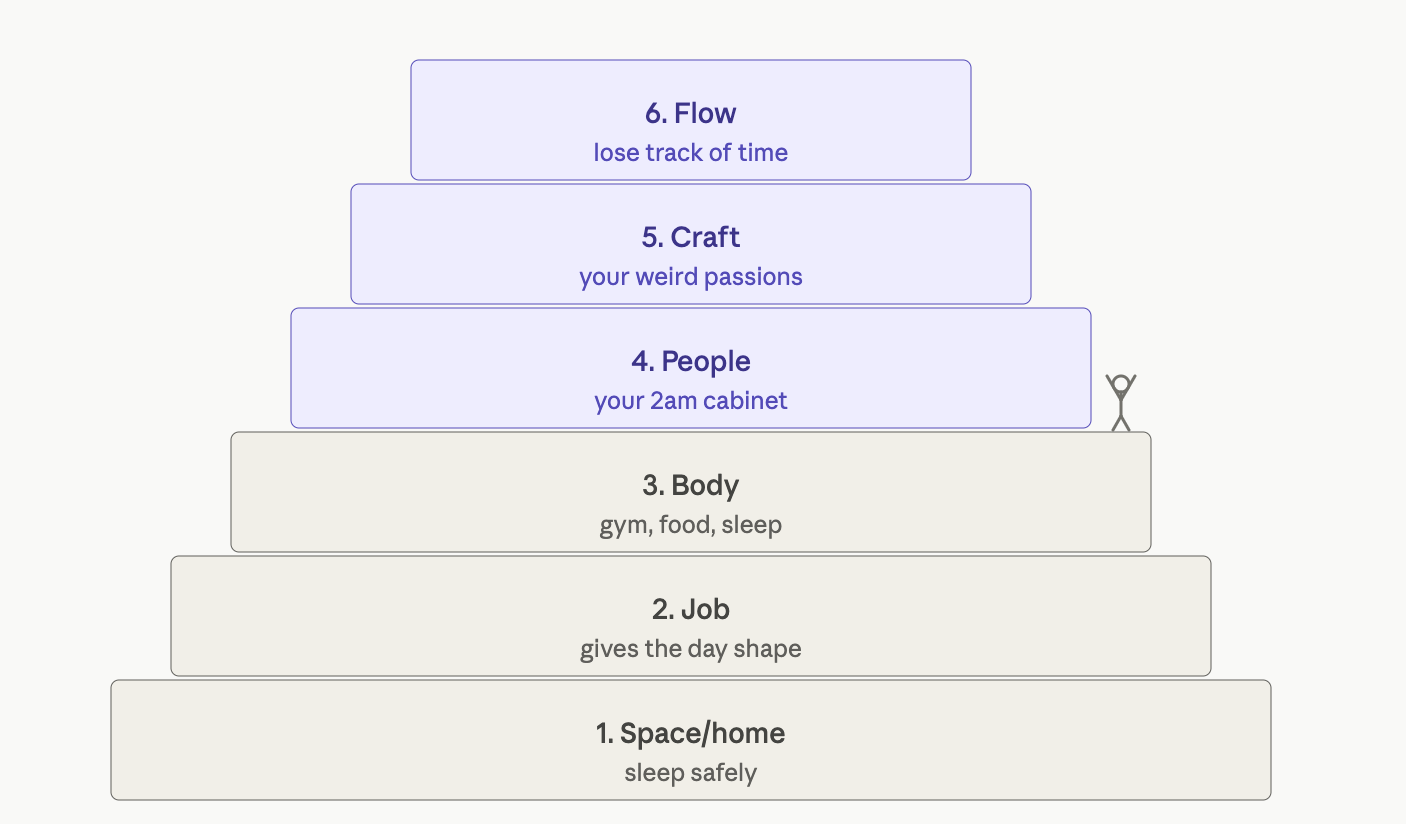
You climb this in switchbacks, not straight shots. You trip. You fall a level. And as long as you don’t get too injured to keep climbing — you just keep chugging.
Trying to skip levels is the rookie move. The seasoned move is to climb badly and laugh. The mess-ups become stories — and stories are what turn somewhere new into somewhere yours.
So, TLDR: Transitions are exhausting. The switching cost is real. And we all deserve a little bit of grace.
And I think all we can really do is lean in. Go hike that pyramid with vigor. Budget that friction with intention. Take the wrong train with a laugh.
And when you inevitably order the below-average Thai food at a choogie tiger-themed restaurant too far east on the Lower East Side, enjoy that damn serenade — and the free shot that comes with it.

—DG
I really like Eliza's framework around how learning to deal with transitions actually helps soften the cost of making them. That's so totally true. I also think it's what builds resilience because change is inevitable and sometimes it's not a choice. Preparing that muscle for that moment is truly invaluable.