
radical feedback
on giving it, getting it, and the #struggle of both

I didn’t mean to burst out crying in front of my boss on our last-day-of-internship Zoom. But there we were.
At a conference we attended, I’d left a poster behind and someone else had to go back and get it. Not my finest moment. But also, in my head, not exactly a defining one.
So when my boss told me I hadn’t “left my ego at the door,” I was… angry.
Me? Entitled? Private school princess Divya Ganesan who quit working at Salt and Straw after three weeks? So THIS is what you choose to focus on after everything else I’ve done?
Then I was sad. The kind of sad where you realize — oh god, I made someone feel like I thought I was above something. And what probably hurt most was that I saw an ounce of truth to it — an insecurity I had about my own qualifications. Thus commenced the waterworks. Brutal.

Today on the #DGFiles we’ll be discussing feedback — giving it, getting it, and why it’s one of the hardest and most important things we do, especially in our twenties.
it’s not you it’s your behavior 🪞
I’ve been thinking about a line my mom used to say. I’d come home from elementary school, fuming about somebody who stole my fruit roll-up or whatever felt world-ending that day. And I’d say something like, “I HATE her.”
My mom would stop me. “No Divya, it’s not that you hate that person. You hate their behavior.”
It annoyed me at the time. But I was reminded of it sitting on that zoom call last summer. Was the feedback my boss gave me about my action accurate? Yeah. But was it a commentary on my identity? Probably not.
Leaving the poster for someone else to deal with was careless. In a fast-paced work environment, that kind of thing reads a certain way regardless of what you meant by it. As a recent grad at a national security startup where most of my colleagues were former military, maybe it was time to read the room.
The real takeaway wasn’t “don’t leave posters at conferences.” It was about awareness — What’s the gap between what I intend and what people experience?

a feedback framework 🧠
My dad has a framework for this that he likely stole from someone else 😉. He says there are two questions to ask when you receive feedback:
1. Is this feedback accurate? Do I trust this person’s judgment? Is this a pattern? Has anyone else said something similar?
2. Is this something I want to change?
These two questions help you sort through the noise. Not all feedback is created equal — both in terms of who gives it to you and who you choose to give it to. Some of it is a gift. Some of it is projection. Some of it tells you more about the giver than it does about you.
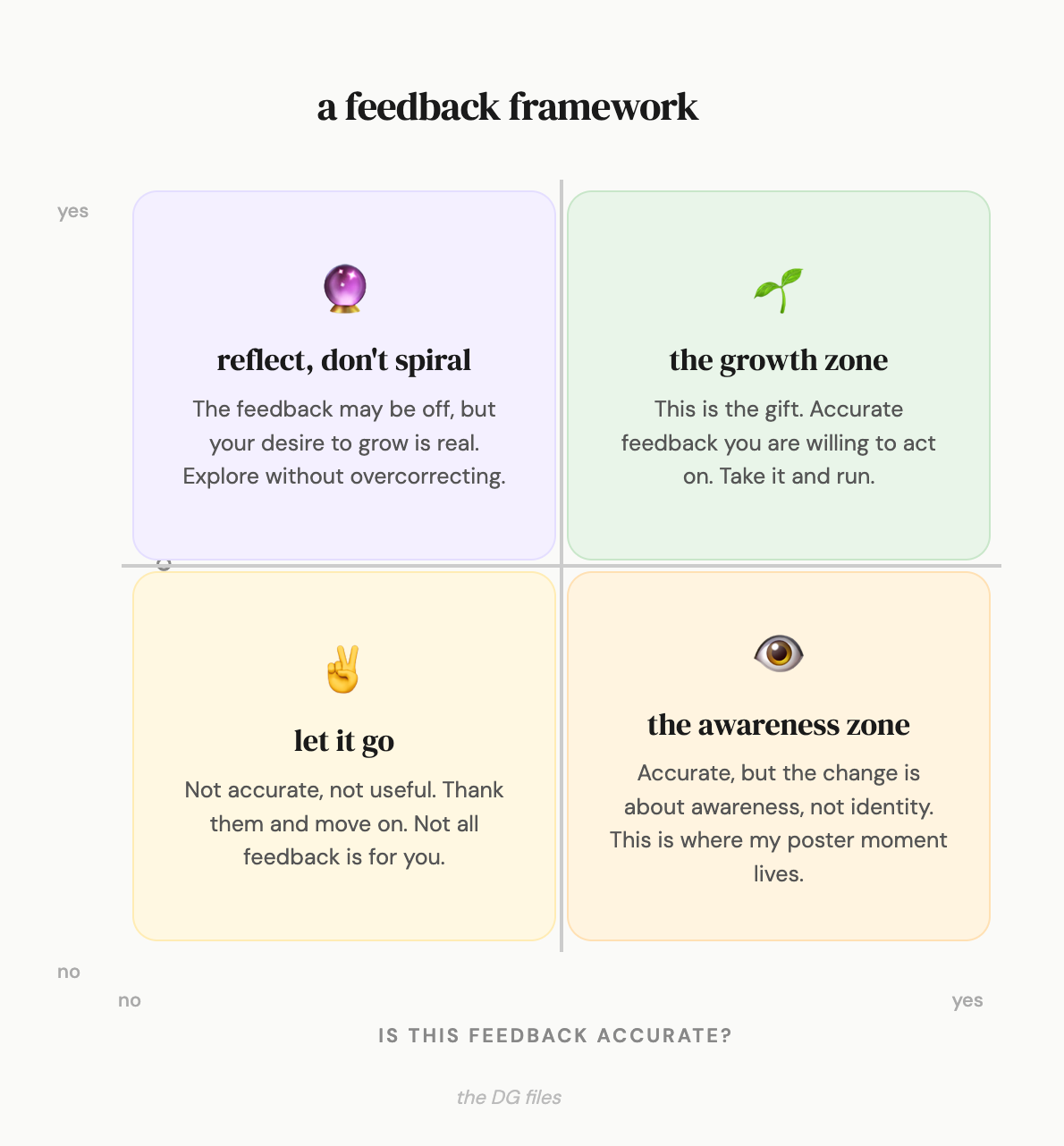
Here’s what I’d add that the graph can’t exactly capture— sometimes the feedback is accurate about the action, not about your character, and the thing you want to change isn’t who you are but how aware you are.
works in progress 🚧
I think this is especially true for those of us in our twenties.
We are works in progress. And what a gift and what a struggle that is.
The struggle is that, as Roger Federer once said, self-belief is earned. And I don’t know about you, but I still feel like I’m in the process of earning mine. We’re in — and I hate to sound like a broken record — a period of great uncertainty, wondering whether we’re actually good enough or just faking it convincingly.
When someone tells you you’re entitled, or that you don’t communicate enough, or that you came across wrong — it doesn’t bounce off a decades-long track record of knowing exactly who you are. It hits harder. And the thing we want most in those moments isn’t even a lesson. It’s validation. We just want someone to say: you’re doing fine, you belong here.
But here’s the gift side: we are more capable of change and learning right now than we may ever be again. Neuroscience tells us our prefrontal cortex — the part that handles decision-making and self-awareness — doesn’t fully mature until our mid-to-late twenties.

As Eileen Gu aptly put it, “Especially as a young person — I’m 22 — with neuroplasticity on my side, I can literally become exactly who I want to be.”
intention and action 🌉
There’s a concept I learned in Psych 70 at Stanford that I think about constantly: the fundamental attribution error. We judge others by their actions and ourselves by our intentions.
When my boss told me I hadn’t left my ego at the door, he was judging my action — and he was right to, because actions are all other people have to go on. But in my head, I was judging myself by my intention, which was never to seem above anything.
Bridging the gap between intention and action (that one was for you @Neel J), is one of the hardest things to do. The phrase “intention and action” usually refers to personal agency but I think it works well in the context of feedback as well. When someone gives you feedback, they’re telling you your actions didn’t match what you probably intended. And when you give feedback, the most generous thing you can do is assume the other person’s intentions were good — even when their actions weren’t.
the other side: giving feedback 💬
Which brings me to the other side: giving feedback. Honestly just as hard. Maybe harder.
I was in the car recently with my sisters Sahana and Avani, and Sahana said something that stuck with me: “It’s not worth giving feedback to someone when you don’t care that much about the relationship.” She has a point. Not everyone deserves your feedback — and that’s not cold, it’s honest. Feedback is an investment. You give it to the people whose growth you’re actually invested in, and whose relationship is worth the discomfort.
Example: I hosted a small event last weekend. As usual, some people showed up and others didn’t. Some communicated, some just ghosted. I could’ve said nothing. But I’ve realized that something really important to me is close friends communicating — and if I never say that, I’m just silently resenting the people I care about, which helps no one. So I told my friends they disappointed me. They’re worth the awkwardness.
I think giving feedback kindly is a form of love. Both to yourself and others. It clarifies your own standards. It frees you from resentment. It says: I think you’re capable of more, and I care enough to tell you.
We are all human. We all suffer from unsaid expectations, disappointments, and disappointing.
So, my proposal for you, dear reader is
radical feedback ✊
Radically give it — early, often, and with kindness. Don’t save it for the last day of someone’s internship. Don’t let it build until it becomes resentment. Say the small thing now (to the people that really matter).
And radically receive it — not necessarily as the truth, but as a way of seeing. Someone else’s feedback is a mirror held at their angle, not yours. You don’t have to accept it as your identity. But you do have to look.
So, tldr: None of us are perfect. Some feedback is a gift. Some is trash. Such is life.
—DG
Thank you for being so vulnerable with your experience and sharing the learning! Today was Peer Critique day and your article was the perfect way to set the stage!!