
goldfish mode 🐟
Success and the City, Ep 5

There are some moments in life I just can’t seem to forget. There was that time I broke up with my boyfriend on a romantic trip to Morocco 🫠. Getting kicked out of a TreeHacks yacht party. A feedback session where my boss told me I “acted with high ego.” These memories live rent free in my head — some of them were really important lessons. Not all of them earned their rent.
I’m a somewhat meticulous person when it comes to remembering. I track my energy weekly, put my self-reflection on public Substacks, and start every Monday with a close friends Instagram dump of the week before.
And yet, my dear reader, on this particular episode of #SATC — I couldn’t help but wonder: could it actually be healthy to develop a practice of forgetting?
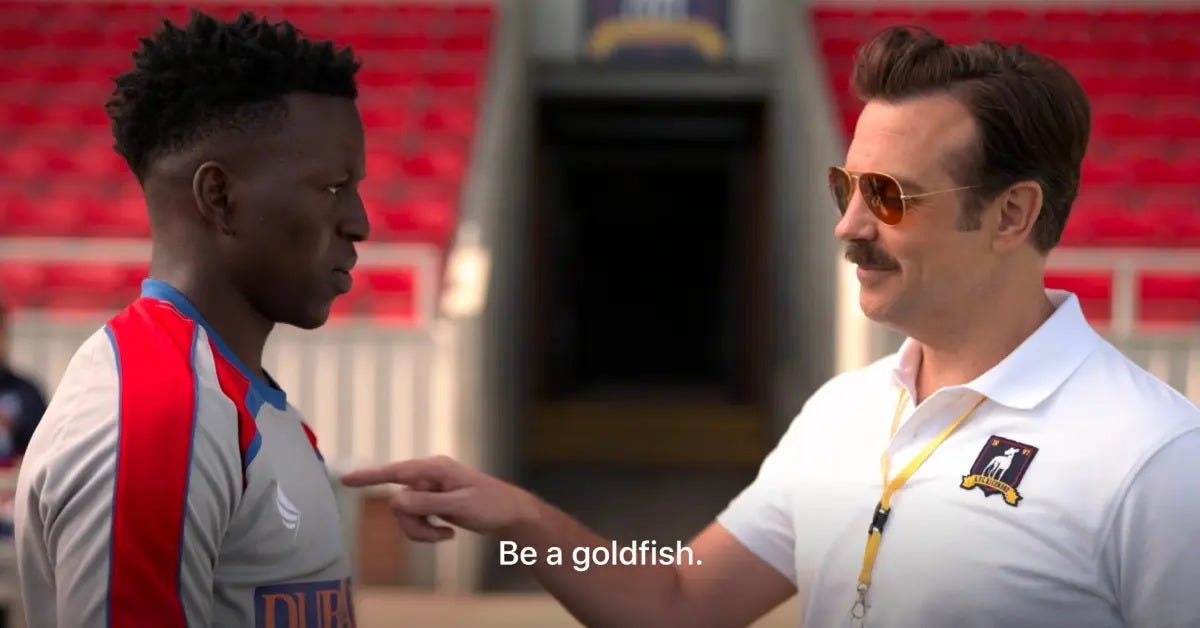
Enter my icon Ted Lasso.
There’s a scene in season one where Sam Obisanya scores an own goal and costs AFC Richmond a point. He’s gutted. Lasso calls him to the sideline. “What’s the happiest animal in the world?” Sam has no idea. “Goldfish. Ten-second memory. Be a goldfish, Sam.”
I loved this so much I had a goldfish on my phone background for a week. It even became the group chat picture for a while.
So I’m sorry to be the one to break this to you — Ted Lasso was wrong.
the myth of the goldfish
Goldfish do not, in fact, have ten-second memories. Scientists at Plymouth University trained goldfish to press a lever for food — and when the lever only worked during one specific hour of the day, the fish learned to show up at exactly the right time. Their memories span months. They recognize their owners. They adapt.
Which means perhaps Ted wasn’t actually telling Sam to forget. He was telling him to do something harder: process the mistake and keep playing. The question was never how do we forget. It’s how do we dwell productively — and then actually stop.
mistake metabolism
Turns out there’s a word for what happens when the loop breaks. Actually, there are three.
Remembering isn’t really a choice. The event happened. Your brain encoded it. You don’t get a say in that — nor should you. It’s data.
Metabolizing is active. You sit with it, feel the discomfort, let it mean something. This is where caring lives, and the discomfort itself is information. It means you have standards. That you give a damn.
Perseverating is the trap. Psychologists use this word to describe the cognitive equivalent of a skipping record: the same thought, replaying on loop. In a very CS way: with no new inputs, the output doesn’t change. You’re running the same function on the same data and expecting a different result.
The healthy version of this process — what I’ve started calling “Mistake Metabolism” — goes like this:
Remember → Metabolize → Reflect → Repair → Release
(A note: this cycle applies to all kinds of experiences — but mistakes are where the loop gets stickiest, and where this matters most.)
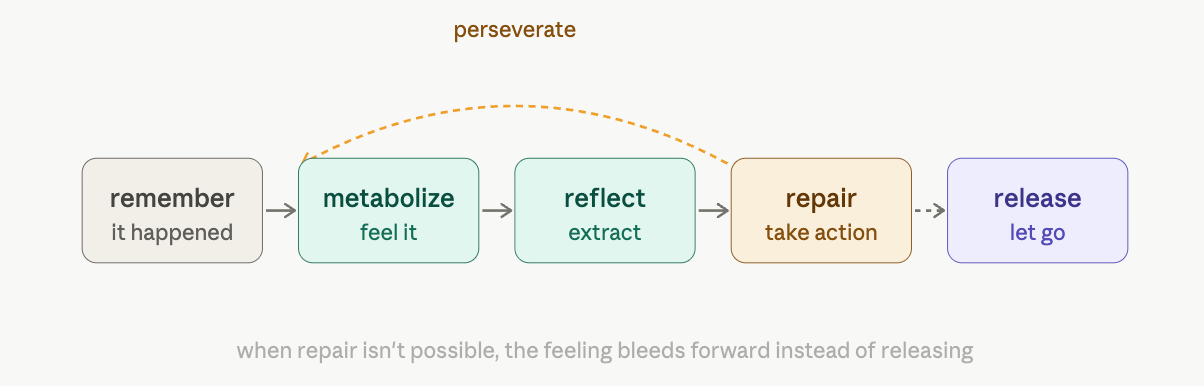
The loop most commonly breaks at repair. When the action that would close it isn’t available, the feeling has nowhere to go — and instead of releasing, it bleeds forward.
The clearest example I have is feedback I received on the last day of a previous job: that I’d offended a coworker. Delivered on my way out, with no opportunity to repair it. The lesson was real and I took it — ask for feedback early, don’t wait until it’s too late to do anything about it. But the unresolved feeling followed me anyway. At my next job I became so careful, so self-monitored, so afraid of repeating something I’d never fully understood, that the overcorrection became its own problem.
The lesson had metabolized. The feeling hadn’t.
That’s the subtler trap. Sometimes the loop breaks not because you refused to do the work, but because repair was structurally impossible. The moment had passed. And so the feeling, with nowhere to go, bleeds forward into the next context, quietly running the show.
When that happens, I think the only move is to name it. To recognize that what feels like appropriate caution is actually an old loop still spinning. That the lesson and the feeling are two different things on two different tracks, and metabolizing one doesn’t automatically metabolize the other.
For example, I keep a running list of learnings at work — tiny behavioral rules distilled from moments that stung. Be proactive about communication. Give yourself 35 minutes for the train. Even traveling needs routines. Each one is a moment of embarrassment converted into a policy. Once it’s in the system, my brain is allowed to let go.
The cost of skipping this work isn’t just staying stuck. It’s making the same mistake twice, with the added tax of having already paid for the lesson once. As Aunty Lisa put it, skipping reflection and repair doesn’t mean you’ve moved on. It means the mistake gets a sequel.
There’s also a presence cost. When you’re perseverating, you’re not here. You’re back on the bus home from a hackathon yacht party, replaying something that already happened during a moment that’s actually happening right now. My dad would call this the opposite of being present. I’d call it paying rent on a memory with a long-standing eviction notice.
high resting mistake metabolism
So: be a goldfish. The real one — the one that learns, encodes, and moves. Not because it forgot, but because it’s done.
I didn’t start this essay convinced that we should learn to forget. I’m ending it convinced that we should learn to metabolize faster — and that those are very different things.
What I’m actually arguing for is a high resting mistake metabolism: the ability to take in failure, convert it fast, and move without accumulating perseveration residue.
The way to build that isn’t to make fewer mistakes. It’s to make more of them — and I’d even argue, to make them publicly. My favorite repair action of late has been texting my high school friends about whatever I just did wrong — and then just GOLDFISH MODE. I’ve found that the loop closes remarkably fast when you have people in your life who meet every mistake with a little humor and the implicit reminder that you’ll survive this one too.
Because here’s the thing: following your gut, making micro and macro decisions, transition-maxxing — all of it is about placing yourself in high-pressure, low-stakes environments and upping the reps. So load up.
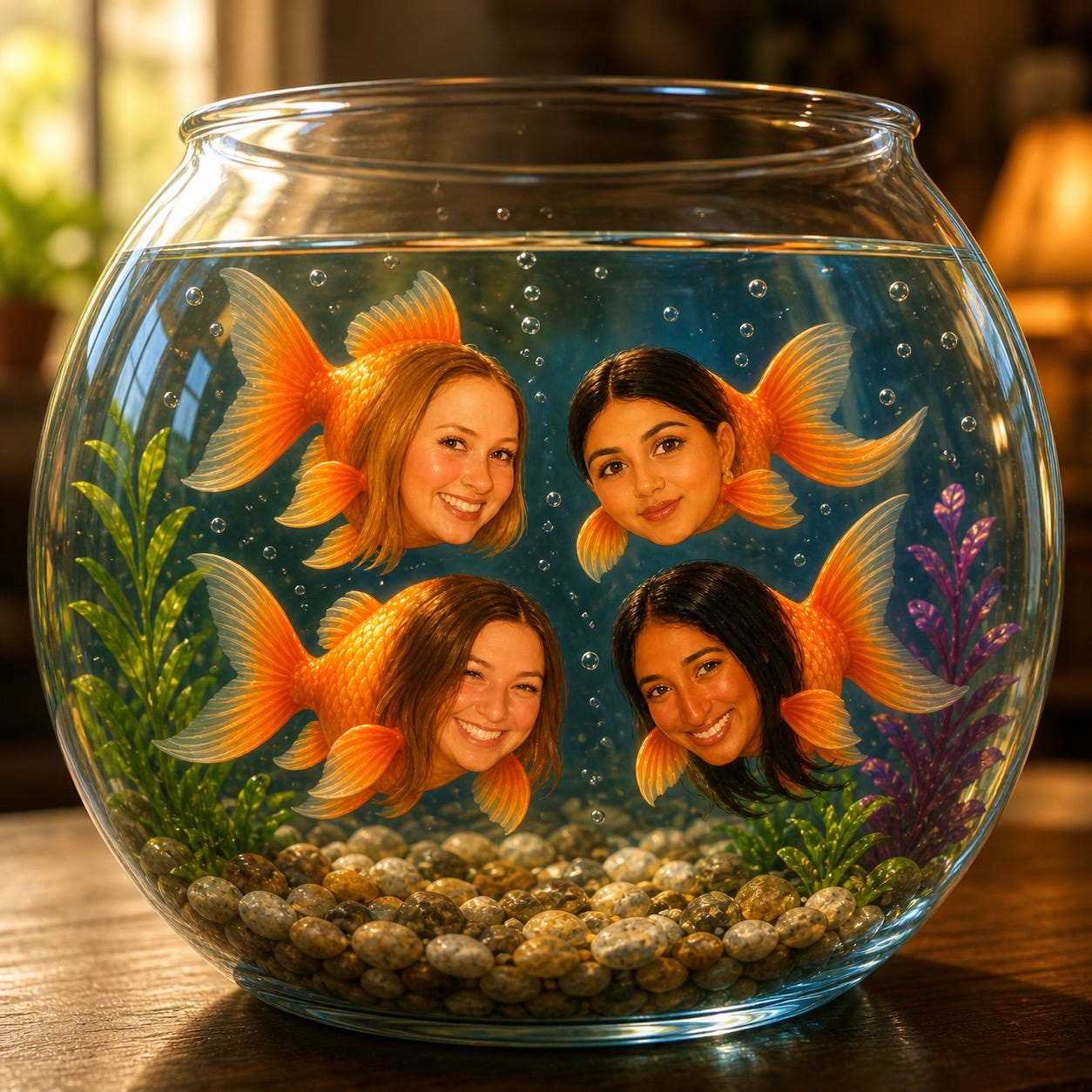
dedicated to sam, tobes, and c dog!!
— DG